VEE INSIGHTS | AEC SERVICES

Stop Rework Before It Starts: Protecting Project Margin Through Earlier Action

Why proactive engineering capacity and early coordination are becoming essential to project profitability

Why Early Action Matters

Project margin can begin to erode long before work reaches the field. Incomplete information, unresolved coordination issues, and late design changes can create rework that becomes significantly more expensive to correct during construction. Addressing these risks early requires the right technical expertise, clear information, and coordination across disciplines.

Vee Technologies’ AEC Services team supports design, modeling, coordination, and technical delivery at critical points in the project lifecycle, helping clients improve visibility and address avoidable rework before it puts project economics at risk.

Early Action

How AEC Services Supports Earlier Action

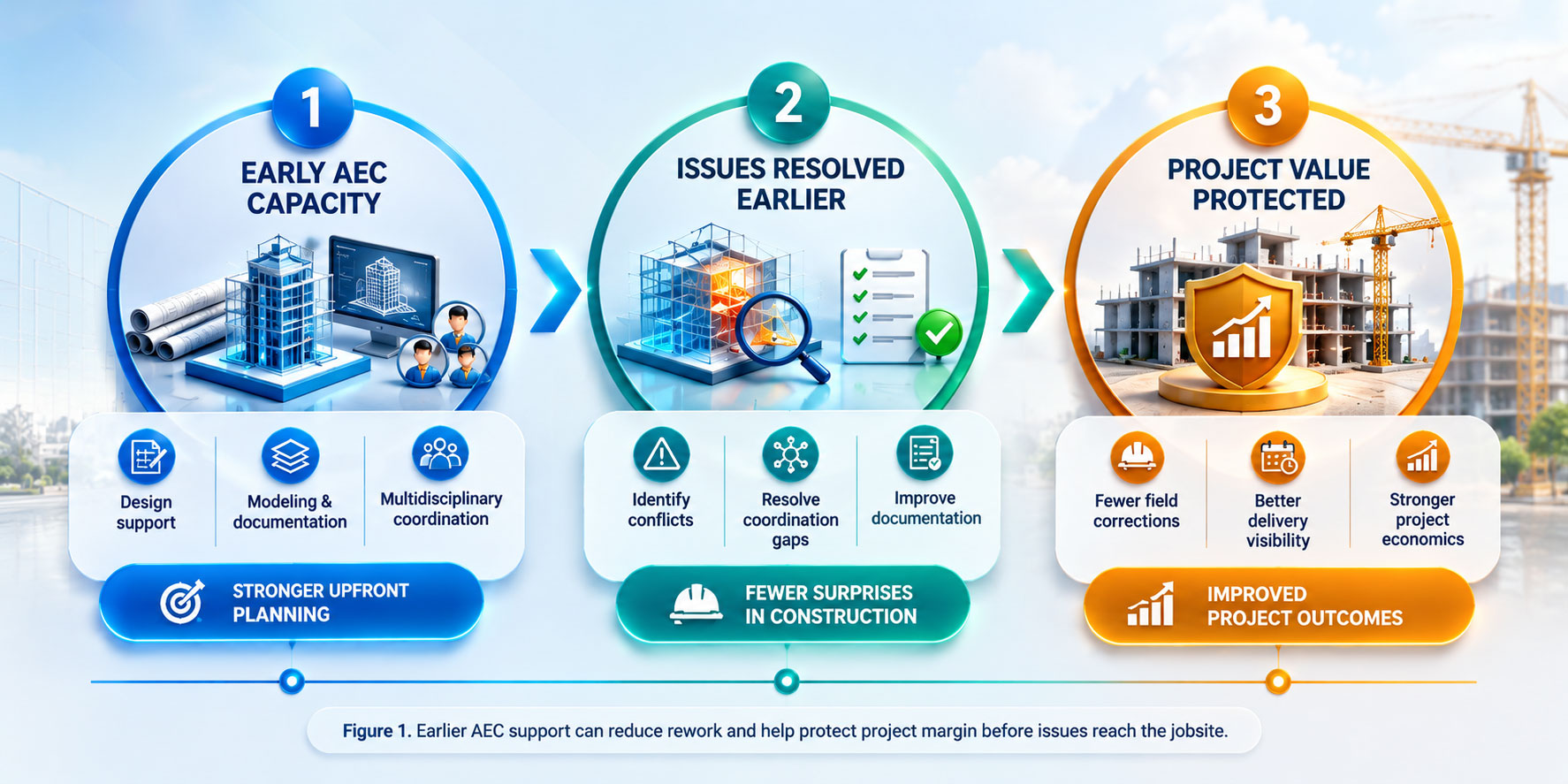
Vee’s AEC Services team provides flexible support for design documentation, modeling, multidisciplinary coordination, constructability review, and other project delivery needs as part of Vee Technologies’ broader portfolio of technology-enabled business services. This support delivers the greatest value when qualified capacity is deployed before problems reach the field, while coordination gaps can still be resolved efficiently and the cost of change remains comparatively low.

How Rework Puts Project Margin at Risk

The business case for earlier support begins with a simple imbalance: rework can cost more than a project is expected to earn. Industry estimates vary, but many studies place rework at approximately 5% to 12% of project value, with higher losses reported on poorly controlled projects. Construction margins, by comparison, are typically in the low single digits. Even when rework costs are shared among project participants, the potential effect on overall project economics is substantial.

TYPICAL PROJECT MARGIN
3%

Expected earnings on project value

THE IMBALANCE
Rework can exceed margin

Early action protects project economics

REWORK EXPOSURE
5–12%

Estimated share of project value

Rework does not just reduce margin. It can erase it.

Consider a $50 million project with an expected 3% margin, or $1.5 million. Rework equal to 5% to 12% of project value would represent $2.5 million to $6 million in total costs across the project. These figures illustrate overall project exposure rather than the amount any single contractor would necessarily bear; actual impacts depend on contractual responsibility, contingency, schedule effects, and claims. Even with those variables, the implication is significant: preventing a portion of avoidable rework can help preserve project value that might otherwise be lost.

Many project losses originate before construction begins. Design omissions, incomplete coordination, conflicting information, and late-stage changes become progressively more expensive to correct after materials are purchased, crews are mobilized, and work is installed. Early access to qualified technical capacity gives project teams an opportunity to identify and resolve these issues while the cost of change is still comparatively low. Strengthening design support, model development, documentation, and multidisciplinary coordination at the right point in the project lifecycle can therefore reduce both delivery risk and the likelihood of costly field corrections.

Earlier AEC support process

Why Additional Field Labor Is Not Enough

The field labor shortage is real. Associated Builders and Contractors (ABC), a national construction industry trade association, projects that the industry will need approximately 349,000 net new workers in 2026 and 456,000 in 2027 to meet demand.

But field capacity alone cannot resolve incomplete design information or coordination gaps. A duct routed through a beam, a wall aligned to an unresolved condition, or a conflict discovered after installation begins still requires correction, regardless of how many people are on site.

Field Labor
"Project readiness depends on having the technical capacity to identify these issues before they become field problems. Protecting margin therefore requires a balanced approach that supports both construction execution and the design, documentation, and coordination work that makes execution possible."

Where Flexible AEC Support Adds Value

Vee’s AEC Services team can provide flexible capacity at the stages of a project where coordination gaps and rework risk are most likely to emerge:

Scalable design and documentation support.

Flexible delivery capacity that expands with the project pipeline, helping clients manage workload peaks without overextending internal teams or adding permanent headcount.

Constructability and coordination review.

A focused review before issue for construction to identify clashes, incomplete information, and design conflicts while they can still be resolved efficiently.

Preconstruction and multidisciplinary support.

Targeted assistance during planning and coordination to help teams close gaps, improve information flow, and reduce the likelihood of downstream disruption.

These services draw on specialized capabilities in engineering support, BIM, VDC, documentation, and coordination. The value is not tied to any single discipline or technology. It comes from timely access to qualified expertise, aligned with project demand and deployed early enough to influence outcomes. That flexibility can help clients manage fixed costs, improve delivery resilience, and preserve value that avoidable rework would otherwise consume.

A Shift From Reactive Delivery to Proactive Project Readiness

One of the biggest opportunities across the AEC industry is to rethink how project capacity is planned. Too often, additional resources are brought in only after schedules are under pressure or coordination challenges have begun affecting delivery. A more proactive approach anticipates where those pressures will occur and puts the right technical expertise in place before problems develop.

This requires more than adding resources. It calls for stronger alignment among design, engineering, and construction teams, better visibility into project readiness, and greater flexibility in how work is delivered. Organizations that treat capacity as a proactive part of project strategy, rather than a response to immediate demand, will be better positioned to protect margins, improve predictability, and scale successfully.

A practical starting point is to evaluate project readiness at key design milestones, looking at unresolved coordination issues, documentation completeness, anticipated design changes, and available technical capacity. These indicators can help teams determine where additional support will have the greatest impact before schedule pressure turns into costly rework.

Protecting Value Before It Is Lost

Some of the most expensive project losses begin before crews arrive on site. Protecting margin therefore requires attention not only to visible labor gaps, but also to the technical and coordination risks that develop earlier. Vee Technologies’ AEC Services team helps clients supplement design, documentation, modeling, and coordination capacity without permanently expanding fixed headcount. By investing in project readiness, strengthening early coordination, and aligning technical capacity with anticipated demand, organizations can reduce rework, improve delivery predictability, and protect profitability as project complexity continues to grow.

A note on the figures: Reported rework percentages vary from study to study. They are presented here as ranges, with each source footnoted, rather than as single fixed numbers.

David Haynes

Meet the Author

Marissa Jacobson - AVP, Operations

Marissa Jacobson serves as the AVP of Client Operations and BIM Management at Vee Technologies. She has over 10 years of experience in architecture and engineering with extensive commercial, residential, and institutional project portfolios with an emphasis on design and management. Marissa fosters an environment of teamwork and ensures that strategy is clearly defined while overseeing design, quality, and technical performance. Her strong communication and client relationships skills enhance Vee Technologies process-driven management style.

100%
Enlarged Infographic
Use + / − buttons, mouse wheel to zoom, or drag to pan