 USA (English)
 France (French)
 Japan (Japanese)
 USA (English)
 France (French)
 Japan (Japanese)

Before You Cut Tooling: The Evidence Behind a Defensible Engineering Decision
Before You Cut Tooling: The Evidence Behind a Defensible Engineering Decision
Tooling commitment turns engineering judgment into physical and financial consequences. The question is not whether the design process is complete, but whether the available evidence is strong enough to support the decision.
Tooling Turns Assumptions into Commitments
The design is still editable on screen. Then tooling begins, and its assumptions start taking physical form.
Geometry begins moving into molds, dies, fixtures, test equipment, supplier instructions, and manufacturing plans. Previously reversible choices acquire physical, financial, and operational consequences. An assumption left unchallenged in the model or drawing may soon be embedded in what is built.
That creates the engineering question: is the design advancing because the evidence supports the commitment, or because the planned activities have been completed?
A finished simulation, test report, risk analysis, or drawing release confirms that work has occurred. None establishes, by its existence alone, that the critical requirement has been addressed, that assumptions remain applicable, or that unresolved findings are understood. Schedule pressure can make document completion look like decision confidence, particularly when each engineering activity has been reviewed separately.
Engineering review before tooling therefore requires more than checking whether expected deliverables are present. Decision-makers need to understand what each item demonstrates, where the evidence agrees, where it conflicts, and what uncertainty will remain after commitment.
Tooling decisions cannot wait for uncertainty to disappear. They do require a defensible basis for accepting it.
The Evidence Threshold
The point before commitment is not defined by completed analyses, reports, or approvals. It depends on whether the available evidence is strong enough for the specific decision.
This is the Evidence Threshold.
Definition: Evidence Threshold The Evidence Threshold is the point at which engineering evidence is sufficiently relevant, credible, traceable, and decision-specific to support a tooling or production commitment while making remaining uncertainty visible.
Crossing it means the relevant requirement has been addressed, the evidence is credible for its intended use, material contradictions and risks are visible, and the reasoning is traceable to the proposed disposition. It does not mean that every uncertainty has disappeared.
The threshold cannot be reduced to a universal score. It must be argued from the evidence available, including its relevance, credibility, coverage, traceability, and limitations. Evidence may be technically sound in isolation yet remain insufficient when its purpose, conditions, limitations, or unresolved actions do not align with the commitment under review.
Evidence volume is therefore a poor substitute for evidence sufficiency. Disconnected documents may provide a weaker basis than aligned sources that address the critical requirement, disclose their limits, and explain remaining uncertainty.
Treating the Evidence Threshold as a certification, fixed checklist, guarantee, or substitute for engineering judgment misreads its purpose: it marks the point at which the case for proceeding can be examined, challenged, and defended.
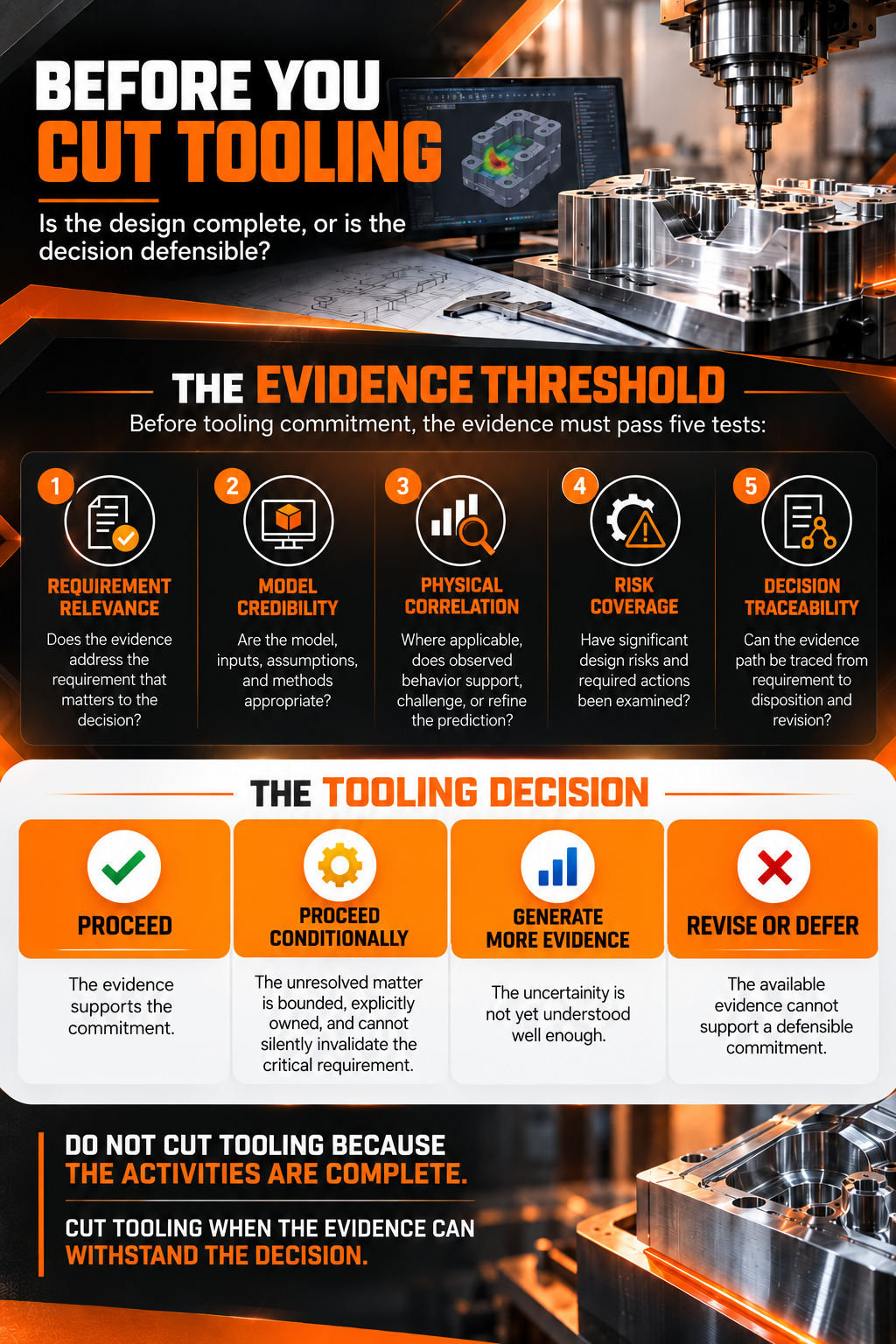
The Five Tests of Decision-Ready Engineering Evidence
Decision-ready evidence must answer five distinct questions about the commitment it is expected to support.
Definition: Design Verification and Validation Design verification asks whether specified design requirements have been met. Validation asks whether the resulting product or system is suitable for its intended use under relevant operating conditions.
Test 1: Requirement Relevance
Evidence is useful only when it addresses the requirement that materially affects the commitment. A technically sound analysis can still be irrelevant if it evaluates the wrong load case, performance measure, interface, or operating condition. The starting question shifts from “What evidence is available?” to “Which requirement must this decision satisfy?”
Decision question: Does the evidence address the engineering requirement that matters to the tooling or production decision?
Test 2: Model Credibility
Analysis results depend on the suitability of the model and the information used to construct it. Assumptions, geometry, material properties, loads, constraints, boundary conditions, and analytical methods should be appropriate for the intended decision. Credibility is contextual: a model suitable for comparing early concepts may not support tooling commitment without further evidence.
Decision question: Are the model, inputs, assumptions, and methods appropriate for the decision?
Test 3: Physical Correlation
Where correlation is applicable, predicted behavior should be compared with observed evidence under sufficiently understood conditions. Agreement can strengthen confidence for the defined purpose; disagreement can reveal limitations in the model, test, inputs, or interpretation. Correlation should refine judgment, not manufacture certainty.
Decision question: Does observed behavior support, challenge, or refine the predicted performance?
Where correlation is not applicable, the review should record the basis for that determination.
Test 4: Risk Coverage
Decision-ready evidence must account for credible ways the design may fail. Potential failure modes, effects, causes, existing controls, and required actions should be examined systematically. The relevant question is not whether every imaginable risk has disappeared, but whether material risks are visible, treated appropriately, and owned.
Decision question: Have significant design risks and required actions been examined before commitment?
Test 5: Decision Traceability
A reviewer should be able to follow the path from the critical requirement through analysis, test evidence, risk treatment, decision, and revision. Traceability makes the reasoning reconstructable and shows where evidence, assumptions, unresolved matters, and design changes entered the decision.
Decision question: Can the evidence path be traced from requirement to disposition and revision?
The five tests are complementary. Relevance identifies the question; credibility and correlation examine the support; risk coverage exposes what could undermine the design; traceability preserves how the decision was reached.
Simulation Is Evidence Only Within Its Assumptions
A simulation does not have to be technically wrong to mislead a tooling decision. It may answer its original question accurately while no longer representing the design or operating condition under review.
A model created to compare early concepts may use simplified geometry, assumed material properties, idealized constraints, or preliminary loads. Those choices may be appropriate at concept stage. If the design changes while the model or its inputs remain unchanged, the apparent precision of the output can conceal a loss of applicability.
Organizations place significant value on simulation during product development. In a 2023 McKinsey-NAFEMS survey of 176 simulation users and technology providers, 87% of respondents identified improved product performance as a current value driver for simulation. The finding underscores why simulation results must be interpreted within the purpose and conditions for which they were developed.
The same risk arises when a result travels farther than its intended purpose. An analysis built to compare two design options may later be treated as evidence of absolute performance. A load case selected for screening may be used to support a production decision. A boundary condition may remain mathematically consistent while no longer reflecting intended use.
The question is not only whether the simulation was performed correctly. Reviewers must ask whether the model remains suitable for the decision now being made, which assumptions still hold, and which limitations must accompany the result.
A useful institutional precedent comes from NASA-STD-7009B. Within NASA programs, the standard links the use of models and simulations to structured assessments of capability, results, uncertainty, and decision consequence, showing why credibility must be considered in relation to how a model will be used.
Simulation-to-test correlation can strengthen that judgment where physical evidence is appropriate and sufficiently comparable. Agreement may support the model for a defined purpose; disagreement may reveal issues in the model, test setup, inputs, or interpretation. Neither outcome should be separated from the conditions under which it was produced.
Definition: Simulation-to-Test Correlation Simulation-to-test correlation compares predicted and observed behavior to assess agreement, investigate differences, and refine confidence in a model for a defined engineering purpose.
A credible simulation is not simply one that runs successfully. It is one whose purpose, limits, and current applicability remain visible when the decision reaches tooling.
What Different Engineering Evidence Can and Cannot Establish
Engineering evidence becomes misleading when one method is asked to establish what only another can show. Correlation, DFMEA, traceability, and the documented basis for a tooling decision answer different questions. None can substitute for the others.
Simulation-to-test correlation cannot establish universal model accuracy, complete requirement coverage, or guaranteed performance beyond the conditions already examined.
Design Failure Mode and Effects Analysis (DFMEA) addresses potential design risk. In automotive practice, the AIAG & VDA FMEA Handbook provides an established reference for this structured method. DFMEA cannot prove that the design will perform successfully or that every failure mode has been identified.
Definition: DFMEA Design Failure Mode and Effects Analysis, or DFMEA, is a structured method for examining potential design failure modes, their effects and causes, existing controls, and actions needed to address risk.
Traceability addresses connection and reconstructability. It can show how a requirement links to analysis, testing, risk treatment, a decision, and later revision. It cannot establish that every item in that chain is technically correct. A complete trail can preserve weak reasoning as faithfully as strong reasoning, which is why traceability must support technical review rather than replace it.
The documented basis for tooling commitment addresses decision defensibility. It should state what evidence was considered, which assumptions and limitations were accepted, where evidence conflicted, what uncertainty remains, and who owns open actions. It cannot promise that tooling will never change or that unanticipated behavior will not emerge.
Accuracy depends on describing each evidence type within its proper authority. Correlation tests agreement. DFMEA exposes and organizes risk. Traceability preserves the evidence path. The commitment record explains why proceeding is considered defensible.
Engineering review should move from isolated reports to connected evidence, so predictions, observations, risks, revisions, and decision conditions can be interpreted together.
One Tooling Decision, Two Evidence Paths
Consider a design approaching tooling release with a critical performance requirement already defined. Analysis is complete, prototype testing has produced usable results, the DFMEA has been reviewed, and the drawings are ready. Nothing appears obviously unfinished. The difference lies in how the evidence is brought into the decision.
In the activity-complete path, each team closes its assigned work. The simulation supports the selected geometry within its documented assumptions. Testing confirms acceptable behavior under the chosen setup. The DFMEA records an open action whose significance is understood within the quality review. Drawing approval proceeds because every required artifact exists. Yet no consolidated review asks whether the analysis and test conditions represent the same requirement, whether the open action affects tooling, or whether later changes have altered the original assumptions.
In the evidence-backed path, the same work is examined chronologically against the commitment. The team confirms the critical requirement, compares the current design with the analyzed configuration, examines the relationship between predicted and observed behavior, and determines whether the DFMEA action must be resolved before tooling or carried forward under explicit ownership. The final disposition records the evidence considered, accepted limitations, remaining uncertainty, and conditions attached to proceeding.
Neither path guarantees the outcome. The distinction is that one advances because the expected activities are complete, while the other advances because their combined meaning has been examined at the point of decision.
A tooling commitment becomes more defensible when evidence is reviewed as a connected argument, not as a collection of finished assignments.
A Practical Review Before Tooling Commitment
Connected evidence does not make the tooling decision by itself. An accountable review requires the right participants, authority, and decision record.
A function with the authority to bring design, analysis, testing, quality, manufacturing, and program considerations into one decision must convene the review. Participants need the critical requirements, current design configuration, relevant evidence, material risk actions, known contradictions, and proposed tooling disposition available at the same time. Separate reviews can leave their combined implications unexamined.
Disagreement should be surfaced rather than compressed into artificial consensus. A simulation-test difference, disputed assumption, open DFMEA action, missing requirement link, or conditional test result does not automatically prevent commitment. Conditional proceeding is defensible only when the unresolved matter can be bounded, explicitly owned, and prevented from silently invalidating the critical requirement. Otherwise, decision-makers should resolve it, constrain the decision, generate further evidence, or defer tooling.
The decision record captures the evidence reviewed, assumptions accepted, contradictions considered, remaining uncertainty, conditions attached to proceeding, required follow-up, and responsible owners, while distinguishing technical recommendations from the authority that approves the commitment.
One accountable decision-maker or governing body must then issue a clear disposition: proceed, proceed conditionally, revise, obtain further evidence, or defer tooling. Shared evidence can inform the decision, but accountability for that decision cannot remain distributed vaguely across functions.
The review does not need unanimous confidence to succeed; it needs a transparent, technically informed commitment with visible conditions and ownership.
Building Decision-Ready Engineering Evidence with Vee Technologies
External engineering support can develop parts of the evidence chain without assuming authority for the final tooling decision. Vee Technologies’ Engineering Solutions can contribute across three evidence functions.
Product design and analysis capabilities, including mechanical design, finite element analysis, and computational fluid dynamics, contribute predictive evidence for evaluating design behavior and alternatives. Their value depends on clear requirements, controlled inputs, stated assumptions, and decision-specific interpretation.
Mechanical testing and prototyping can add physical evidence through prototypes, material analysis, process validation, Design of Experiments, and relevant mechanical testing. These activities can help compare predicted and observed behavior under defined conditions without prescribing one testing strategy for every analysis.
Engineering Change Management can preserve revision continuity through Engineering Change Requests and Engineering Change Notices. This connects identified changes, approved modifications, and updated documentation, supporting the revision leg of decision traceability.
These capabilities strengthen specific parts of the evidence chain without replacing the organization’s review authority. Requirements, acceptance conditions, unresolved risks, and responsibility for the tooling disposition must remain explicit between customer and engineering partner.
Vee Technologies supports the work behind a defensible commitment; the authority to proceed remains with the organization making it.
Conclusion: Evidence Before Commitment
Complete certainty is rarely available when an engineering commitment must be made. What decision-makers can require is visibility into the remaining uncertainty, an understanding of its implications, and explicit ownership before proceeding.
The strongest tooling decision is not supported by the greatest number of documents. It is supported by evidence whose relevance, limits, contradictions, and reasoning can withstand review.
Evidence-backed engineering makes commitment defensible not by promising the outcome, but by making the basis for proceeding clear.
Explore Vee Technologies’ Engineering Solutions or discuss the evidence required before your next tooling commitment.
Frequently Asked Questions
When should an engineering team establish the evidence needed for a tooling decision?
Evidence expectations should be defined when the decision, critical requirements, and consequences of commitment become clear, not after analysis and testing are complete. Early definition helps teams select relevant methods, identify evidence gaps, assign ownership, and avoid producing technically sound work that does not answer the tooling question.
What should happen when simulation and physical test results do not agree?
The difference should be investigated rather than averaged away or treated automatically as model failure. Teams should examine test conditions, instrumentation, material data, geometry, loads, boundary conditions, model assumptions, and result-processing methods before deciding whether to revise the model, repeat the test, or constrain the decision.
Does every simulation require physical testing and correlation?
No universal rule applies to every analysis. The need for physical testing and correlation depends on the decision consequence, model maturity, novelty, available prior evidence, applicable standards, uncertainty, and the feasibility of testing. The chosen evidence strategy should be proportionate to the risk and purpose of the decision.
When should a DFMEA be updated during product development?
A DFMEA should be revisited when requirements, design features, intended use, interfaces, materials, manufacturing assumptions, test findings, or known failure information change. Updating it only at formal milestones can leave new risks or ineffective controls disconnected from the engineering decision they should influence.
How should engineering evidence be handled when part of the design or analysis work is performed by an external engineering partner?
Evidence ownership should remain explicit across organizational boundaries. The customer and engineering partner should agree on requirements, assumptions, input sources, review responsibilities, deliverables, revision controls, and acceptance conditions before work begins. The final decision record should distinguish evidence produced externally from the authority responsible for approving the tooling commitment.