VEE INSIGHTS | AEC SERVICES

Digital Transformation as a Service for the Built Environment

Why better building data matters before better software.

Executive Summary

Digital twins, AI, smart buildings, connected operations, they're everywhere right now. And sure, those tools can be valuable. The trouble is that they're often treated like the first step, when they're really the payoff you get after the basics are in order. After thirty years working alongside architects, contractors, owners, and all the messy reality of building information, one pattern keeps showing up. Teams buy impressive technology, then get stuck on questions that shouldn't be hard to answer about buildings they already own.

Where is this asset? Which air handler serves this space? Is this equipment still under warranty? When was it commissioned? Most of the time, the software isn't what's failing. The data is. This paper looks at why so many digital transformation efforts in building and facility operations stall before they produce real value, and why the highest return move an owner can make is often far less flashy: organize building information, check it, and put rules around how it's maintained.

The Day I Stopped Believing Software Was the Answer

Joe confession! For a long time, I believed the fix for most of our industry's problems was just better software. I've spent most of my career around BIM, digital twins, and building technology. The software has become faster, smarter, and more connected. Yet the same problems keep showing up.

Then something became impossible to ignore. The tech kept getting better. The same problems kept showing up. I've sat in more turnover meetings than I can count where someone confidently says, “Everything is included.” And then a basic question lands on the table. “Which air handler serves Conference Room B?”

Turnover Meeting Confusion

And the room goes quiet. A PDF gets opened. Someone searches an Excel spreadsheet. Another person says, “Commissioning probably has it.” Ten minutes later, everyone is still looking.

We Don't Have a Technology Problem

If you walk onto almost any project near the finish line, you won't find an information shortage. You'll find the opposite. BIM models, drawings, submittals, commissioning reports, O&M manuals, spreadsheets, and emails. Thousands of pages.

At first, it looks like the owner is being handed something valuable. What they often receive, though, is a mountain of disconnected material that was never meant to line up cleanly. Picture moving into a new house. The previous owner hands you every receipt, every manual, every warranty card, every contractor invoice, plus all the construction photos. That's a lot of detail. But it's not arranged in a way that helps you live in the house.

When something breaks, finding what you need turns into an afternoon project, not a thirty-second search. That's what turnover looks like in many buildings today. Owners aren't lacking information. They're buried under it.

Where Things Begin to Fall Apart

This is familiar to almost everyone: One document labels a unit AHU-1. Another calls it AHU-01. Commissioning writes it up as Air Handler 1. The maintenance system lists North AHU. The BAS tags it AHU_MAIN. Same equipment. Five names. To a computer, and often to the humans working across these systems, those might as well be five separate assets.

Now scale that across thousands of devices in a hospital, a university, an airport, or a data center.

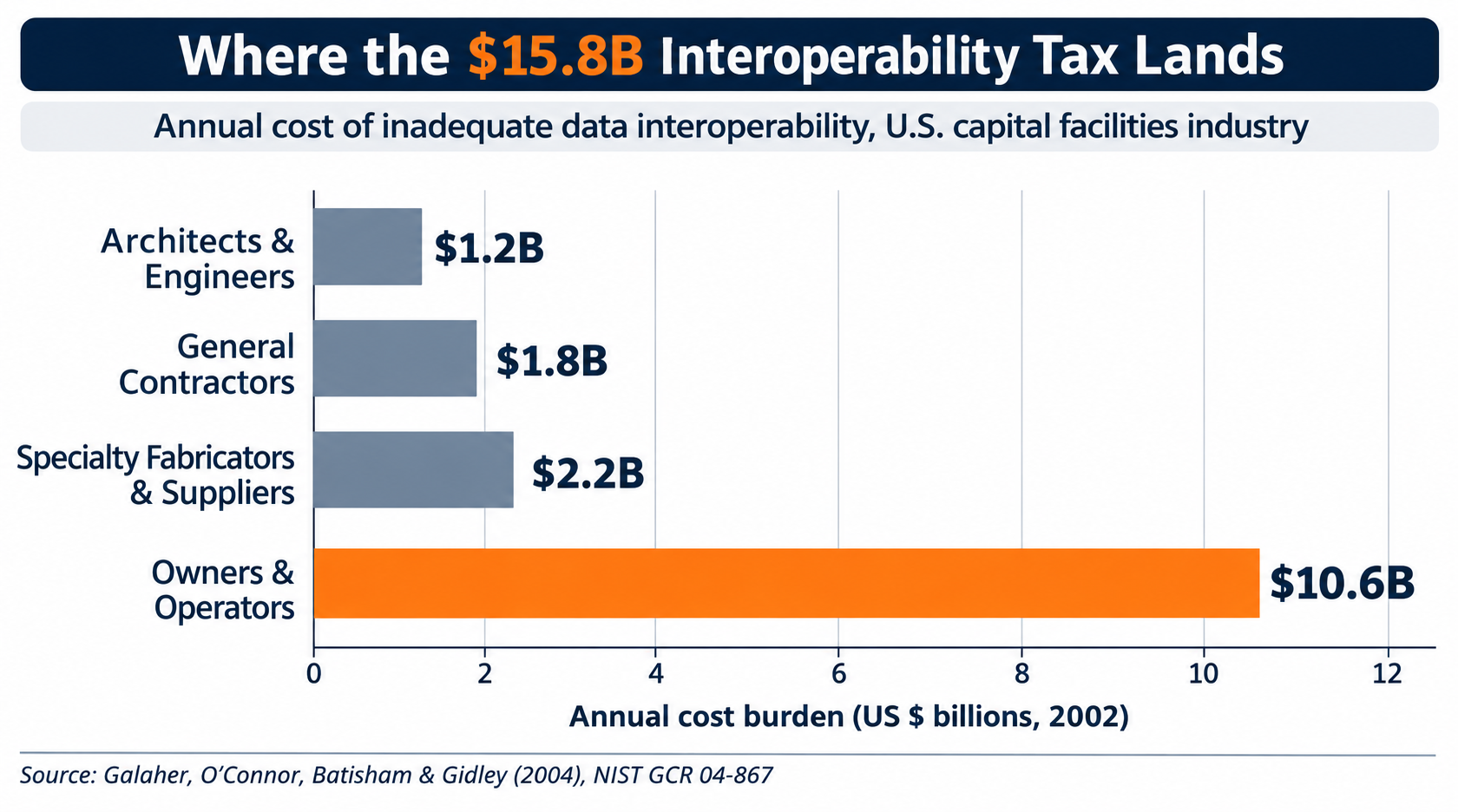
At that point, getting accurate information isn't just hard, it's expensive. NIST's study on the U.S. capital facilities industry put a number on it: inadequate data interoperability drains an estimated $15.8 billion a year, and owners and operators, the people living with the building after handover, absorb two-thirds of that cost.

nist-data-cost-chart

This is also where digital twins get blamed for problems they didn't create. People say, “They don't work.” Often, the truth is simpler: they were built on inconsistent information from day one. A digital twin can't magically create trustworthy data. It can only show what it's fed. Garbage in. Garbage out.

Better Data Creates Better Decisions

When building information is reliable, everything downstream improves. Maintenance becomes proactive. Capital planning gets sharper. Warranty claims are easier to support. Digital twins become useful, and AI finally has information it can trust. Notice what all of those improvements have in common, they didn't start with software. They started with data.

85%

of building operators say they struggle with poor or fragmented facility data.

50%

report losing more than 10% of their time to it; nearly a quarter lose over 20%.

Autodesk & IFMA, 2023 facility data survey

If an owner asked me over coffee where to begin, I wouldn't recommend another platform. I'd ask one simple question: Can you trust the information behind your building? Once the answer is yes, every technology investment that follows becomes dramatically more valuable. That's where digital transformation of building operations really begins.

So Where Does Digital Transformation as a Service Fit?

Technology isn't the hard part anymore. Most owners can buy a digital twin platform, a CMMS, an analytics dashboard, or even AI. What they can't buy off the shelf is clean, reliable building data.

That's where Digital Transformation as a Service for the built environment makes the difference. It starts by organizing the building and facility information behind the technology. Assets are verified, naming is standardized, BIM models are connected to equipment records, commissioning data is validated, O&M documents are organized, and governance is put in place, so the data stays accurate over time.

In the built environment, Digital Transformation as a Service isn't about deploying another platform. It's about building the trusted data foundation that allows building technology investments to deliver real value. For many owners and facility teams, that's the difference between owning digital tools and using reliable building information to improve operations.

Sources

joe-gould

Meet the Author

Joe Gould - Director of Client Operations – AEC

Joe Gould brings nearly 20 years in architecture and 16 years at Autodesk to a career focused on making the built environment work better. As Director of Client Operations – AEC at Vee Technologies, he connects client goals with the people and services that deliver them—from BIM and project coordination to building data and digital twin readiness. He brings an architect’s eye and a practical streak to digital transformation, with a firm belief that a good strategy should survive contact with a real project.

100%
Enlarged Infographic
Use + / − buttons, mouse wheel to zoom, or drag to pan

Ready To Start?

Connect with our experts for tailored solutions to your most urgent business challenges.

Get in Touch

Looking For a Job?

Ready to grow your career? Join a global team that values innovation, impact, and individual growth.

View Open Role